
Biosecurity Aquaculture for Stronger and Safer Farms
Aquaculture is expanding rapidly, but as production becomes more intensive, disease prevention is becoming just as important as feeding, water management, and stocking density. Biosecurity aquaculture is now a central part of modern aquatic animal health management because disease can spread through water, animals, equipment, people, vehicles, feed, and other connections within the production system. For shrimp, fish, and other farmed aquatic species, a well-designed biosecurity program can help farmers identify risks earlier, reduce opportunities for pathogens to enter production areas, and respond more effectively when health problems appear.

Recent international work has placed greater attention on risk-based aquatic health management. FAO describes aquaculture biosecurity as part of a broader approach that combines prevention, mitigation, surveillance, preparedness, and disease management. In 2026, FAO also highlighted aquatic biosecurity through a One Health perspective, emphasizing the links between farmed animals, wild aquatic populations, ecosystems, and human activities.
What Biosecurity Aquaculture Really Means
Biosecurity aquaculture refers to the management practices used to reduce the introduction, establishment, and spread of infectious diseases within aquaculture operations. Instead of waiting until animals become severely sick before taking action, biosecurity focuses on identifying potential hazards and controlling them before they become major production problems.

In a shrimp farm, for example, pathogens may enter through untreated water, infected post-larvae, wild animals, contaminated equipment, workers, vehicles, or movement between ponds. Once a pathogen enters an interconnected production system, water movement and shared equipment can create additional pathways for transmission. This is why biosecurity should not be considered a single treatment or disinfectant. It is a complete management system involving multiple layers of prevention.
FAO's Progressive Management Pathway for Aquaculture Biosecurity, or PMP/AB, applies a risk-based approach that can be adapted to different aquaculture sectors and production systems. Its objective is to improve aquatic health while reducing disease risks across farms, value chains, and national systems.
Why Biosecurity Aquaculture Matters More Than Ever
Modern farms often operate at higher stocking densities and depend on intensive feeding, water exchange, transportation, and movement of aquatic animals. These practices can increase production efficiency, but they can also create more opportunities for pathogens to spread if health management is not carefully controlled.

FAO reported that farmed aquatic animal production increased from 87.5 million tonnes in 2020 to 103 million tonnes in 2024, while total aquaculture output reached 142 million tonnes with a value of approximately USD 371 billion. As the sector grows, aquatic disease becomes an increasingly important production and economic concern.
The challenge is particularly significant for shrimp farming. Diseases such as Acute Hepatopancreatic Necrosis Disease and other emerging pathogens can affect production and require rapid surveillance and response. Recent FAO biosecurity activities in Sri Lanka included emergency preparedness exercises for priority shrimp diseases, demonstrating the importance of coordinated disease response before an outbreak occurs.
For farmers, this means that biosecurity aquaculture should be viewed as an investment in production stability rather than simply an additional operating cost.
Start With Healthy Stock and Controlled Entry
One of the most important principles of biosecurity aquaculture is controlling what enters the farm. Healthy and traceable seed or juvenile aquatic animals can reduce the possibility of introducing pathogens into production systems.
Before stocking, farmers should consider the health history and source of post-larvae, fingerlings, broodstock, or other aquatic animals. New animals may require appropriate screening or quarantine procedures depending on the production system and local disease risks. The same principle applies to water, feed, equipment, and other materials entering the farm.

Farm boundaries and entry procedures can also help create a first line of defense. Dedicated equipment for different production zones, controlled visitor access, appropriate cleaning procedures, and clear movement protocols can reduce unnecessary contact between potentially contaminated areas.
This approach is consistent with the risk-analysis principles promoted by FAO, which include assessing disease risks associated with the movement of live aquatic organisms and examining risks along the aquaculture value chain.
Water Management Is a Critical Biosecurity Barrier
Water is one of the most important elements in aquaculture, but it can also become a major pathway for disease transmission. In open aquatic environments, pathogens can move through shared water sources, drainage channels, water exchange systems, or connections between ponds.
Effective biosecurity aquaculture therefore requires farmers to understand where water comes from, where it goes, and how different production areas are connected. Water intake and discharge should be managed according to the farm's disease risks and local conditions. Where appropriate, treatment or filtration systems can provide additional protection.
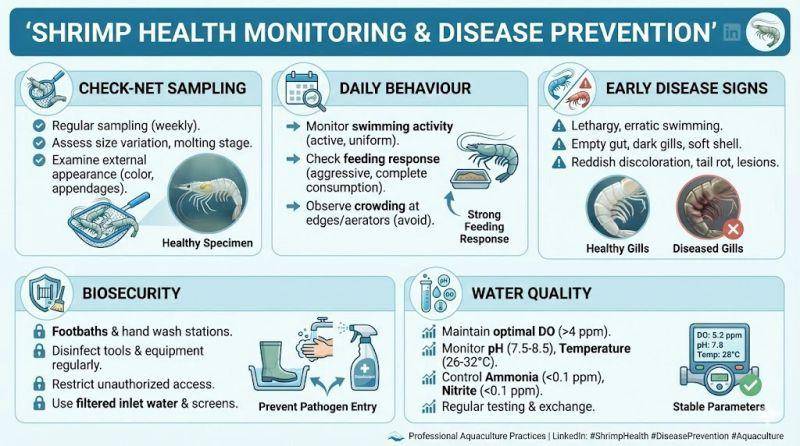
Water quality monitoring should also be part of daily farm management. Parameters such as dissolved oxygen, temperature, pH, salinity, alkalinity, and ammonia can influence animal stress and overall health. Poor environmental conditions do not automatically cause infectious disease, but they can weaken the production environment and make animals more vulnerable to health problems.
This is particularly relevant as climate patterns change. FAO notes that rising temperatures, altered salinity, and extreme weather events can influence pathogen distribution and increase the potential for disease emergence and transboundary spread.
Clean Equipment and Separate Production Zones
A biosecurity plan can lose much of its effectiveness if equipment is moved freely between ponds without appropriate cleaning and disinfection. Nets, buckets, pumps, aeration equipment, sampling tools, vehicles, and other materials can potentially transfer biological material from one production area to another.
A practical biosecurity aquaculture system should therefore establish clear equipment-management procedures. Where possible, equipment can be dedicated to individual ponds or production zones. When shared equipment is necessary, appropriate cleaning and disinfection procedures should be followed before it moves into another area.
Farm workers also play an important role. Movement should ideally follow a logical direction from lower-risk areas toward higher-risk areas rather than constantly moving back and forth between ponds. Footwear, protective clothing, gloves, and hand hygiene may also form part of the farm's biosecurity protocol depending on the production system.
Daily Monitoring Can Detect Problems Earlier
One of the strongest features of modern biosecurity aquaculture is early detection. Farmers should not rely only on obvious mortality before investigating animal health.
Changes in feeding behavior, swimming patterns, appearance, growth, molting, coloration, or feed conversion can provide useful early signals. In shrimp production, farmers may also observe changes in swimming behavior, gut fullness, hepatopancreas appearance, shell condition, or unusual accumulation around pond edges.
Daily records are valuable because they allow farmers to compare current conditions with normal production patterns. When an unusual change appears, the response can begin earlier.
Modern biosecurity is also becoming increasingly connected with digital technology. FAO's Sustainable Aquaculture Biosecurity project has explored tools such as mobile applications, real-time monitoring sensors, and data-driven early-warning systems to strengthen disease surveillance and response.
Biosecurity Needs a Clear Emergency Response Plan
Even strong preventive systems cannot guarantee that a farm will never experience a disease event. The purpose of biosecurity aquaculture is to reduce risk and improve the ability to respond when a problem occurs.
A farm should have predefined procedures for unusual mortality, abnormal animal behavior, suspected disease, and unexpected water-quality changes. These procedures may include isolating affected areas, limiting animal and equipment movement, increasing monitoring, collecting appropriate samples, contacting qualified aquatic animal health professionals, and recording important information.
Emergency preparedness is becoming an important component of international aquatic health management. FAO's recent work in Sri Lanka included disease simulation exercises designed to test response procedures and identify gaps before an actual outbreak occurs.
This demonstrates an important principle: preparation should happen before the crisis, not during it.
Biosecurity and Sustainable Aquaculture
A strong biosecurity aquaculture program is closely connected with sustainable production. Preventing disease can reduce production losses, protect animal welfare, improve resource efficiency, and support more stable farming operations.
Biosecurity also extends beyond the individual farm. Aquaculture facilities are connected through water systems, animal movement, transportation, processing, markets, and surrounding ecosystems. Wild aquatic animals may interact with farmed populations, while pathogens can potentially move across geographical boundaries.
FAO's current One Health approach emphasizes that aquatic ecosystems, wild populations, farmed animals, and human activities are interconnected. This makes collaboration among farmers, researchers, industry organizations, laboratories, and government authorities an important part of long-term aquatic health management.
In Asia-Pacific, WOAH and NACA continue to support regional aquatic animal disease reporting. The 2026 reporting framework emphasizes early detection, monitoring disease trends, coordinated responses, and safer trade.
Building a Smarter Biosecurity Aquaculture Strategy
The future of biosecurity aquaculture is moving toward prevention, monitoring, data, and coordinated action. Rather than depending on one product or one management technique, modern farms can build several protective layers around their production systems.
The first layer is controlling what enters the farm. The second involves maintaining appropriate environmental conditions and managing water pathways. The third focuses on hygiene, equipment, personnel, and animal movement. The fourth involves continuous health surveillance. The final layer is preparedness for rapid response when unusual signs appear.
This layered approach can make disease management more systematic and measurable. FAO's PMP/AB framework similarly promotes progressive improvement, surveillance, preparedness, and sustainable health-management systems rather than a single universal solution.
For shrimp and fish producers, the message is increasingly clear: healthy production starts before disease appears. Strong biosecurity aquaculture practices can help farms become more prepared, more resilient, and better positioned to manage the health challenges associated with intensive production, environmental change, and increasingly connected aquatic value chains.
